Finding your body shape should make getting dressed less annoying, not give you another rule to follow. The usual labels are simply a way of describing proportion. A mirror, a tape measure, and a few honest fitting-room memories will tell you more than a quiz that asks whether you prefer jeans or skirts. You are looking for the places where clothes need room, the places where they fall loose, and the lines you enjoy seeing on yourself.
Begin with the body you have on an ordinary Tuesday
Put on leggings or close-fitting shorts and a simple top, then stand in front of a full-length mirror with your arms relaxed. Do this in daylight if you can. A badly placed bathroom light can make anyone look unfamiliar. Look at the relationship between your shoulders, bust, waist, and hips rather than hunting for a perfect outline. Does your shoulder line look close to your hip width? Does your waist pull in clearly, gently, or hardly at all? Which part seems to set the overall width of your silhouette?
Try not to pose. Many of us automatically tip a hip, lift the chest, or twist slightly toward the mirror. That is fine for a photo, but it hides the shape a shirt or coat has to fit during the rest of the day. Take one step back and look at your side view too. A fuller bust, a long torso, or a high hip can affect the way a dress hangs even when the front view looks quite balanced.
If the mirror check feels strangely emotional, make it dull on purpose. You are observing fit, like noting the width of a doorway before buying a sofa. The goal is not to find a flattering answer. It is to notice a few useful facts before a sales page or an arbitrary size chart starts telling you a story.
Take four measurements, then take them again
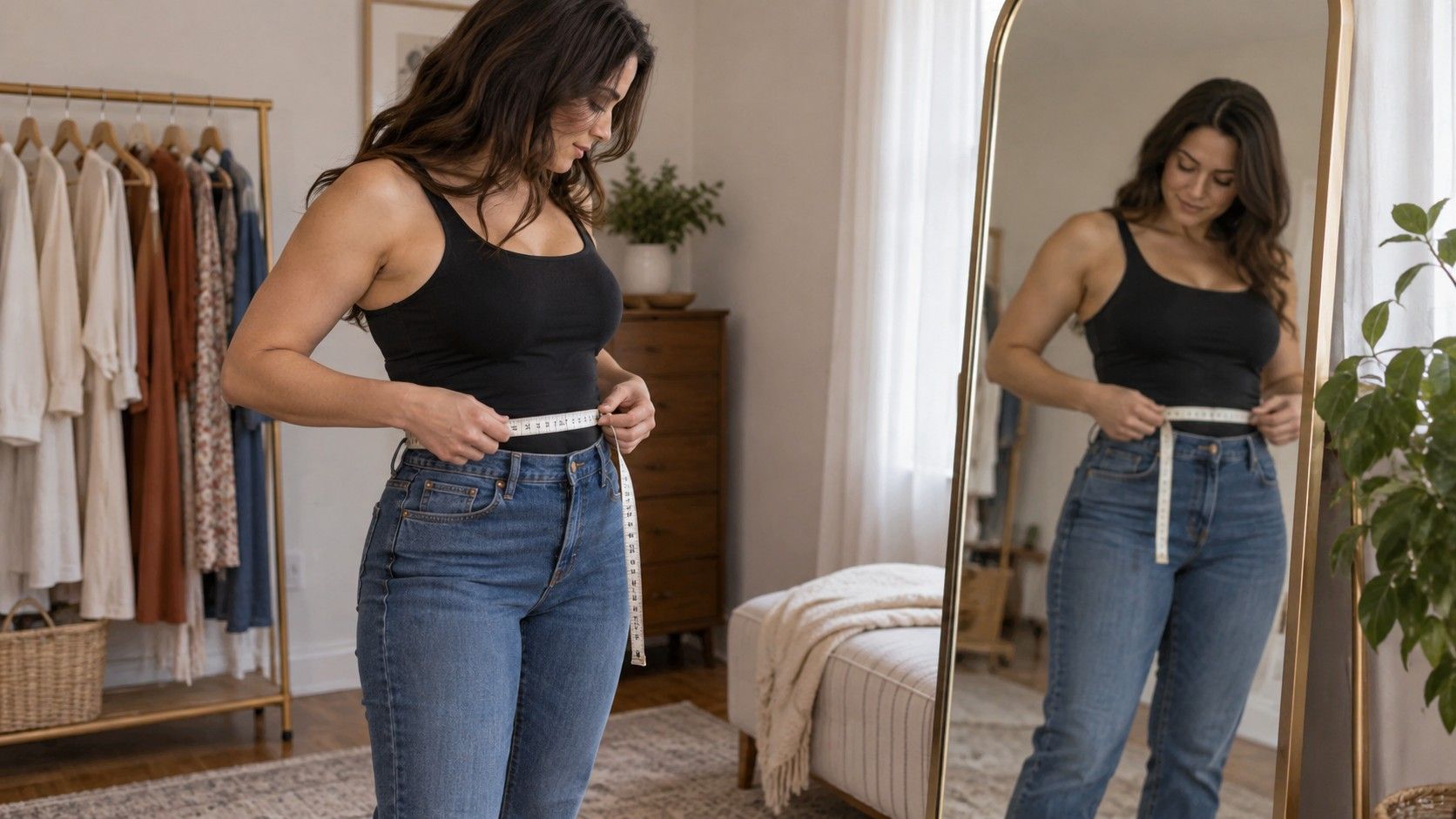
A soft measuring tape is worth using because the numbers give the mirror check some ballast. Measure your bust around its fullest point, with the tape level across your back. Find your natural waist by bending gently to one side and locating the crease, then stand upright before measuring. For the full hip, wrap the tape around the widest point of hip and seat. A high-hip measurement, taken several inches below the waist, can also explain why skirts that look promising on a hanger feel wrong once they are zipped.
Keep the tape against your body without pulling it tight. A squeezed measurement is only a record of how hard you pulled. Take each number twice, preferably while wearing the bra you normally use under everyday tops. Support changes both the bust measurement and the way a fitted bodice sits. If two readings differ, take a third and use the middle number rather than deciding one is more flattering.
Shoulder width is awkward to measure alone, so let a familiar jacket help. Notice where its shoulder seam ends. If the jacket becomes tight across the upper back before it reaches the bust, your shoulders may be one of your main fit points. If it fits the shoulders but swings loose below the ribs, the issue is probably not shoulder width at all.
| What you notice | Label you may see | A more useful question |
|---|---|---|
| Bust and hips are similar, with a defined waist | Hourglass | Where should a waist seam or belt sit? |
| Hips set the fit more often than shoulders | Pear | Which trouser cuts give enough hip room? |
| Shoulders or bust set the fit first | Inverted triangle | Do sleeves and the upper back have enough ease? |
| Bust, waist, and hips read fairly even | Rectangle | Do I want shape from the cut, fabric, or neither? |
| The middle needs more ease than arms or legs | Apple | Where does this top skim instead of cling? |
Compare broad patterns, not tiny ratios
This is where a body shape test can become unnecessarily fussy. You do not need a spreadsheet or a magic difference of two inches. Look for broad relationships. Bust and hips that are close in width with a noticeably smaller waist are often described as an hourglass proportion. If your lower half determines trouser and skirt size while the upper body is easier to fit, pear-shaped language may be handy. If a blazer is chosen for the shoulders or bust long before the hips come into play, inverted-triangle advice may explain some of your shopping frustrations.
Rectangle is often used for a straighter line through the waist and hip. Apple is often used when the middle needs more room while legs or arms are relatively slim. Neither word tells you how you should look. They only give a rough description of where fabric tends to sit. The labels were never designed to capture every variation of a real body, and they do a poor job when treated as strict categories.
You may also find that the upper and lower body point to different labels. That is normal. Someone can prefer pear-oriented jeans because of hip fit and still choose jackets with an hourglass-style waist because that cut feels good. Keep the observations that solve an actual problem. Leave the rest behind.
Let fitted clothes provide the evidence
Your wardrobe is usually more revealing than a diagram. Pick a button-front shirt, a jacket, a pair of high-rise jeans, and a dress with a visible waist seam. These pieces fail in different places, which makes them useful. A shirt that gaps at the bust but feels roomy at the waist needs more room through the chest. That does not mean you have discovered a permanent body category. It means the shirt was drafted for a different proportion.
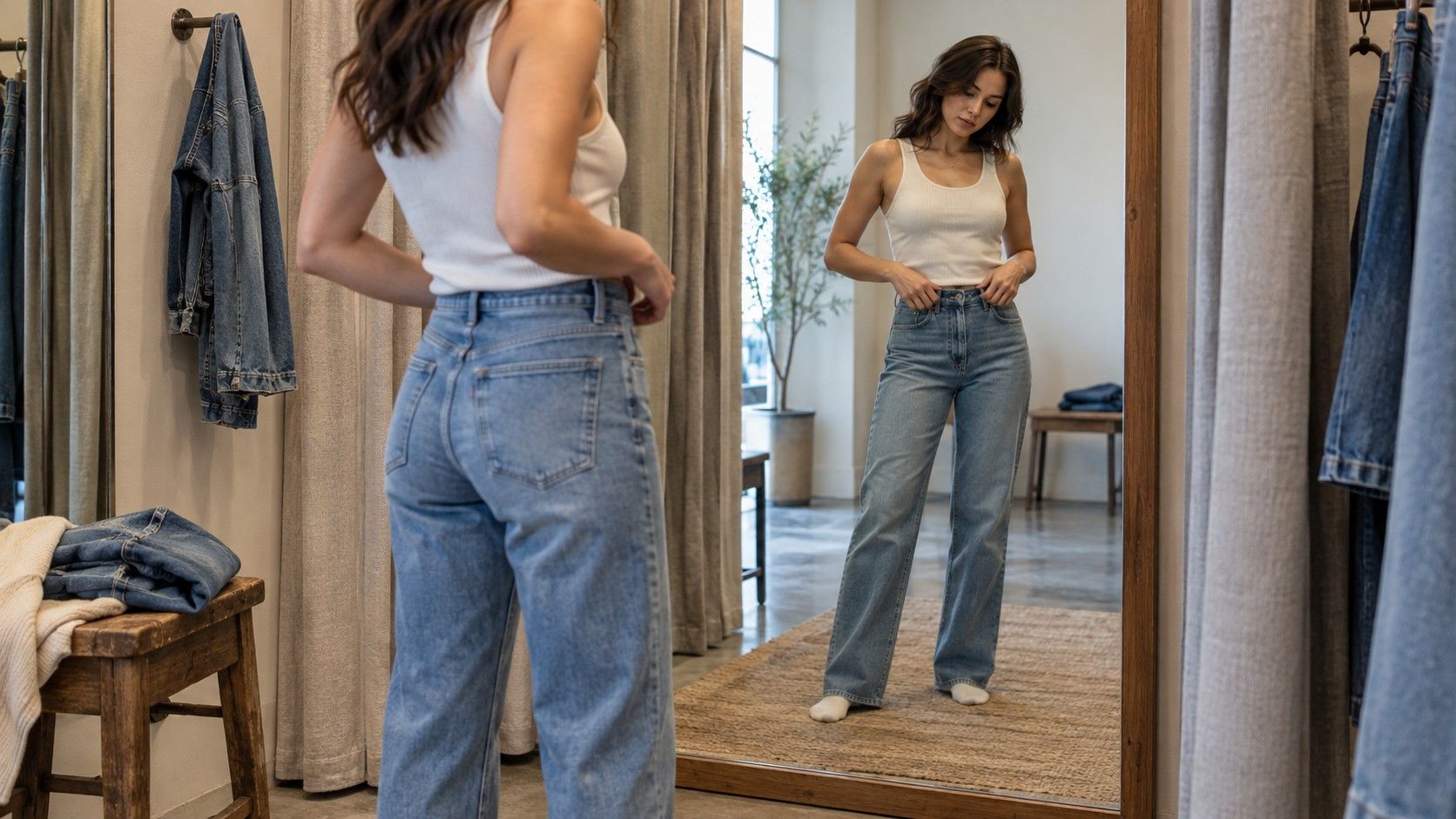
Jeans are especially honest. If they fit through the hip but gape at the back waist, a contoured waistband, a curvier cut, or a small waist alteration may help. If a pair becomes tight at the thigh before the waistband is comfortable, choose for the thigh and judge the waist separately. The number on the tag is a poor referee here. Two pairs from the same brand can have different rises, back yokes, and stretch levels.
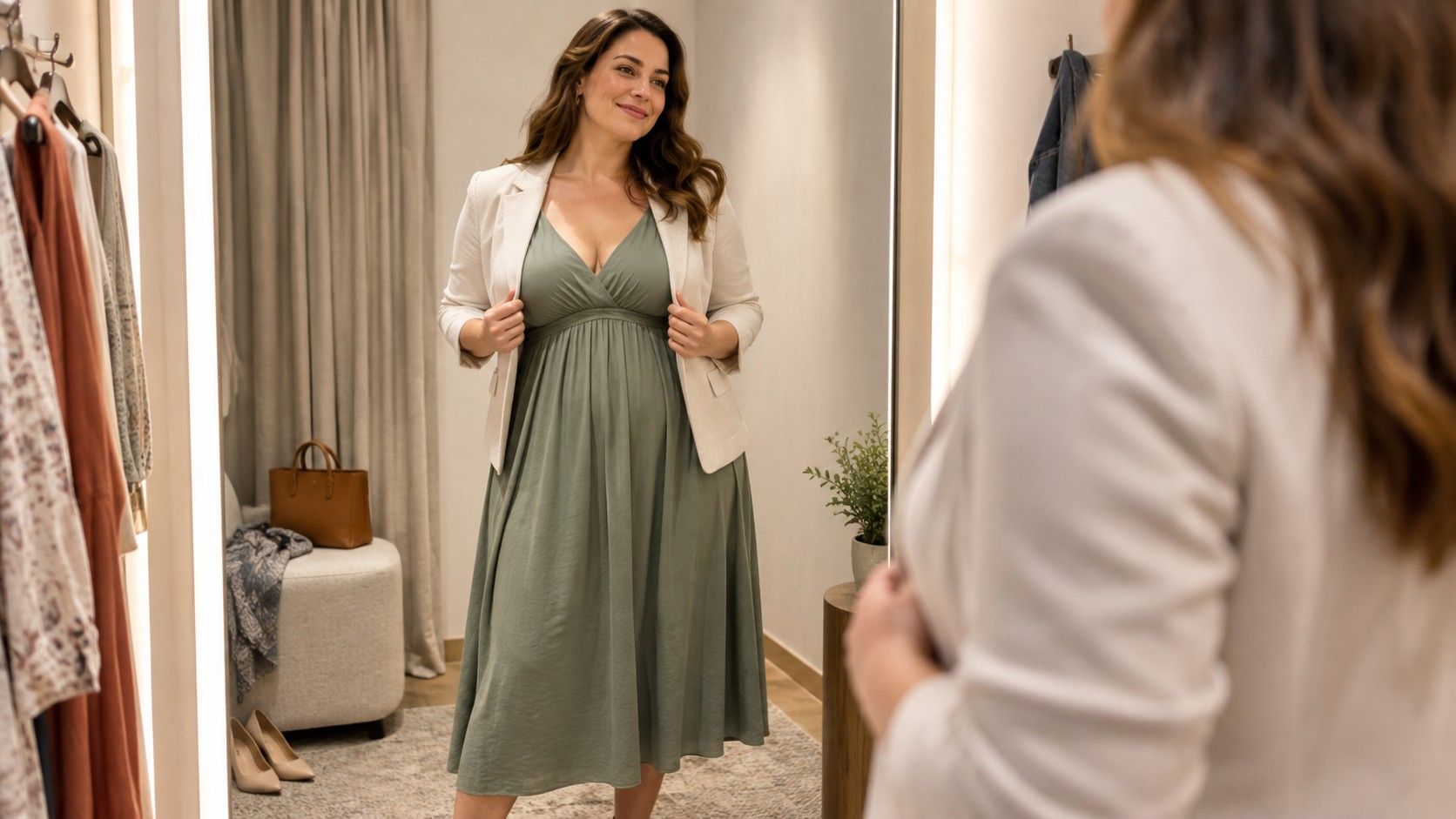
Move while you try things on. Sit down, reach for a high shelf, bend as if you have dropped your keys, and look at the side view. A dress that looks polished for thirty seconds can start climbing, twisting, or pulling after five minutes. The item that you stop adjusting is often the better choice, even if it gives a less dramatic mirror moment.
Expect your shape to overlap and change
People are often disappointed when no single chart seems to describe them. That is partly because charts make bodies look static. Posture, age, weight changes, strength training, pregnancy, and hormonal changes can alter the balance of bust, waist, and hips. Even a change in bra style can alter how a top looks. You do not need to choose a new label every time your measurements move; you only need to update your fit notes when shopping becomes difficult.
Clothing changes the picture as well. A soft knit wrap dress can make the waist look more defined, while a structured shift dress creates a straighter line. A cropped jacket can lengthen the leg line for one person and feel awkward on another because their torso is longer. Both reactions can be accurate. The garment is part of the silhouette, so the same person can look different in different cuts without anything being wrong.
It helps to separate comfort from trend language. If a loose top feels good but you dislike the volume around the waist, try a lighter fabric or a partial tuck before deciding that all relaxed tops are unsuitable. If a fitted dress feels restrictive, the problem may be the fabric recovery or the placement of the waist seam, not the fact that it shows your shape.
Turn observations into a practical shopping filter
Once you know what body shape you are closest to, use that knowledge at the point where it saves time. Identify the part that usually determines your size: shoulders in coats, bust in shirts, high hip in skirts, or waist in dresses. Start with that measurement on a size chart. Choose the size that gives enough room at the non-negotiable point, then decide whether the rest can be adjusted. Taking in a waist or shortening a hem is usually simpler than creating room across tight shoulders.
Make a short note on your phone after a successful purchase. It can be plain: mid-rise straight jeans, soft crew neck, jacket ending at high hip, dress waist one inch above natural waist. Include the fabric when it matters. A cotton shirt with no stretch and a jersey top may need completely different sizes even if the measurements look similar online. After a few notes, you will recognise patterns faster than any general style rule can teach you.
Use the same filter for clothes you already own. Pull out three pieces that you wear without thinking and compare their seams, rise, neckline, and length. Then look at the things that stay in the wardrobe. The contrast may show that you like a clear waist, need a little more shoulder ease, or simply dislike stiff fabric. Those are useful conclusions because you can act on them.
Keep the result flexible and useful
The best answer to what body shape am I is rarely one word. It is more like a small set of directions: fit trousers at the hip, check shoulder seams first in jackets, look for a waist seam that does not cut across the bust, and ignore dresses that require constant tugging. That is enough to narrow a search without making your wardrobe feel like a test.
Try a body-shape label for a season, not a lifetime. Borrow an idea, wear it on a normal day, and see whether it lets you sit, walk, eat lunch, and get through the afternoon comfortably. If it works, keep the detail. If it does not, the diagram is the thing that failed, not you.