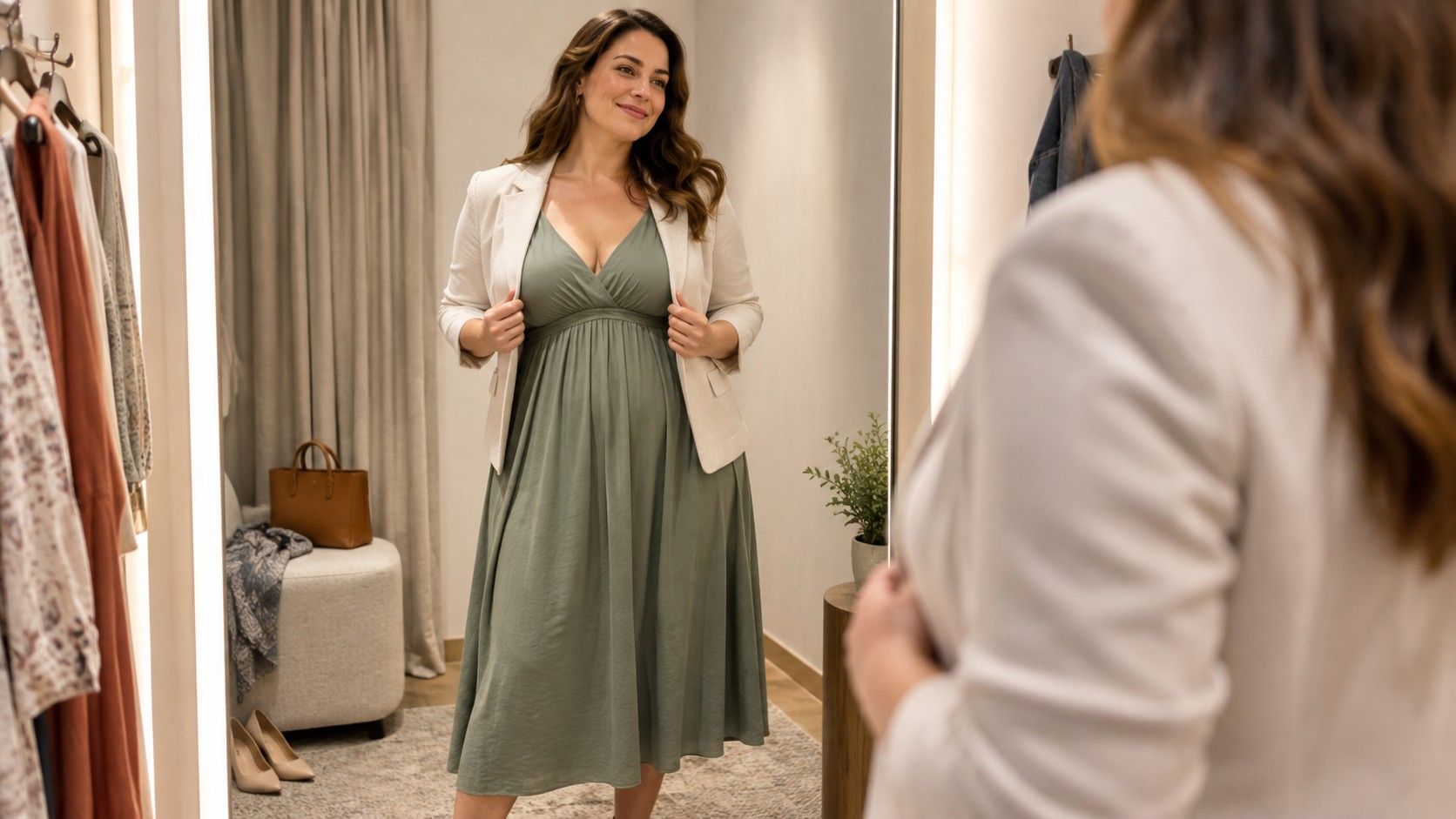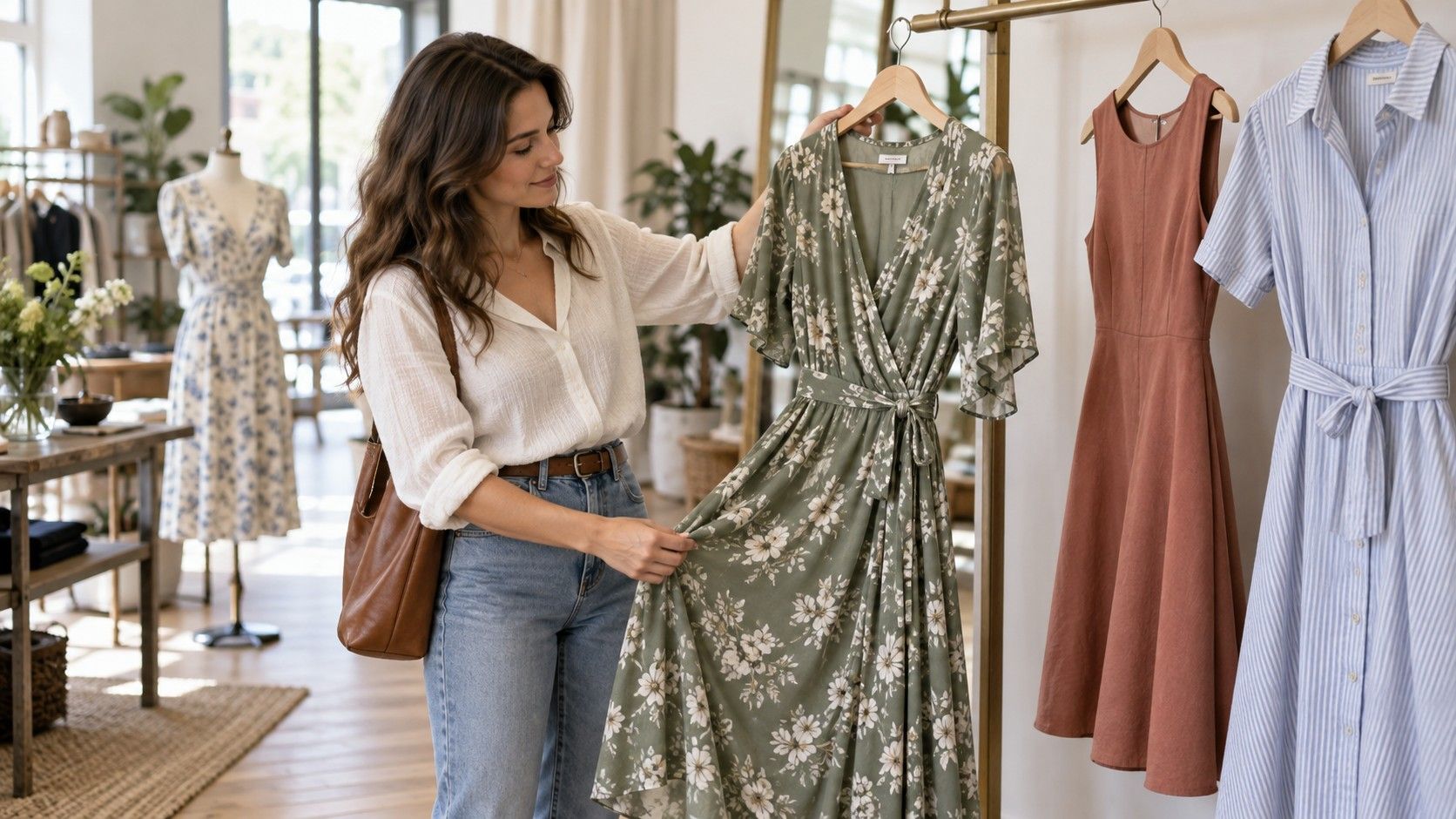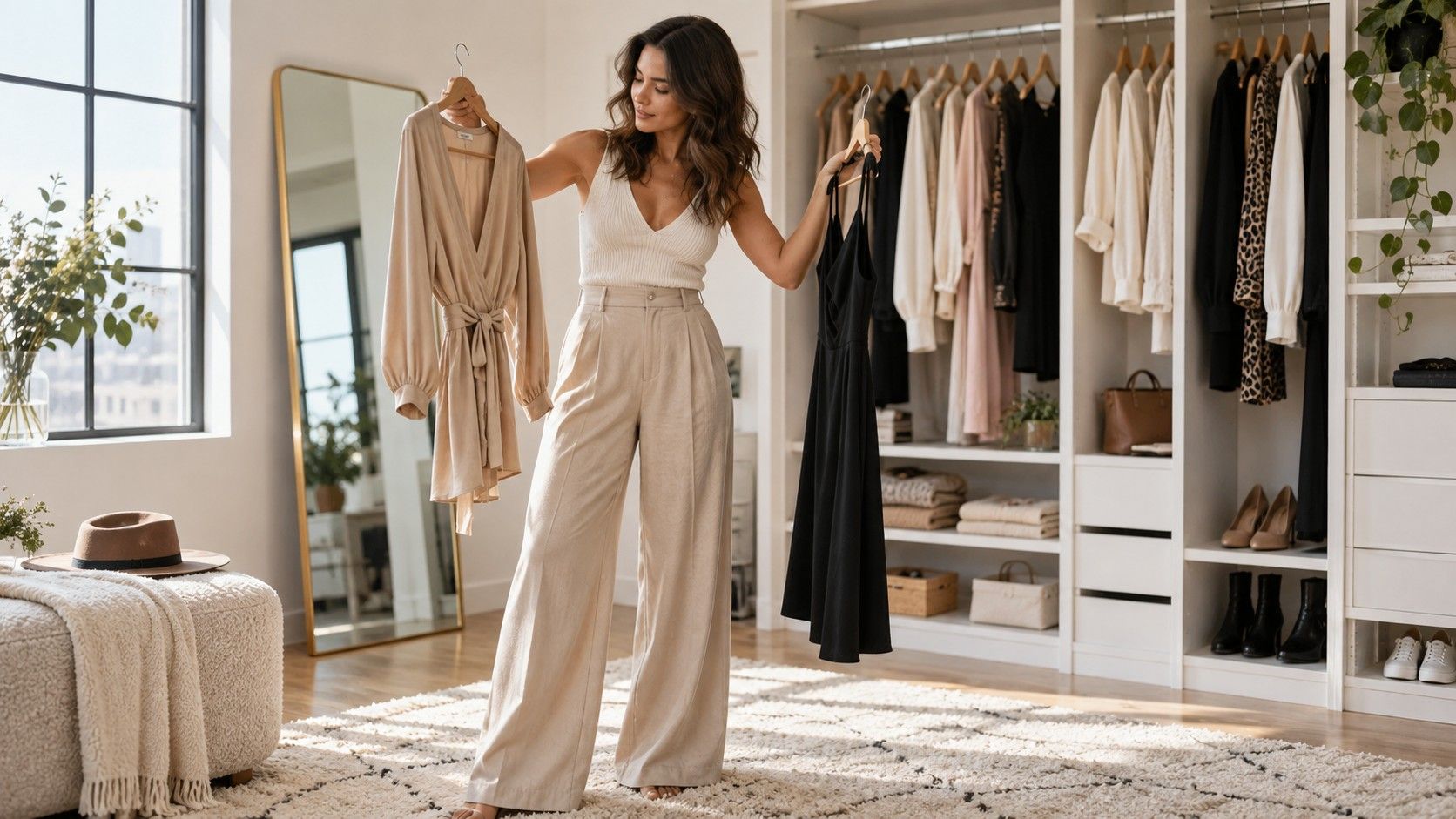
An inverted triangle body shape often reads as shoulders or bust appearing broader than the hips. It can make jackets look strong, sleeveless tops look polished, and simple trousers look wonderfully clean. Styling is less about reducing anything and more about choosing where an outfit has visual weight. On days when you want a softer balance, a calm upper half and a little movement below the waist can do a lot. On other days, there is no reason not to enjoy a bold shoulder line.
Confirm the proportion before building rules around it
Look at your outline in a fitted T-shirt and straight-leg trousers. If the shoulder line is the widest point, or your upper half seems more prominent than your hips, the inverted triangle label may be useful. It is only a starting point. A broad shoulder can come from a structured blazer, a large bust, athletic muscle, posture, or simply the camera angle. Do not buy a new wardrobe because of one category; use it to test an outfit decision you already care about.
A helpful test is to photograph three versions of the same outfit: with a boat neck, a V-neck, and an open shirt. Then compare the whole silhouette, not only the neck area. A V-neck often creates a vertical break and feels lighter; a boat neck makes the shoulder line more visible. Neither is automatically better. The one that works is the one that supports the mood, comfort, and occasion you had in mind.
Let the lower half carry some of the visual weight
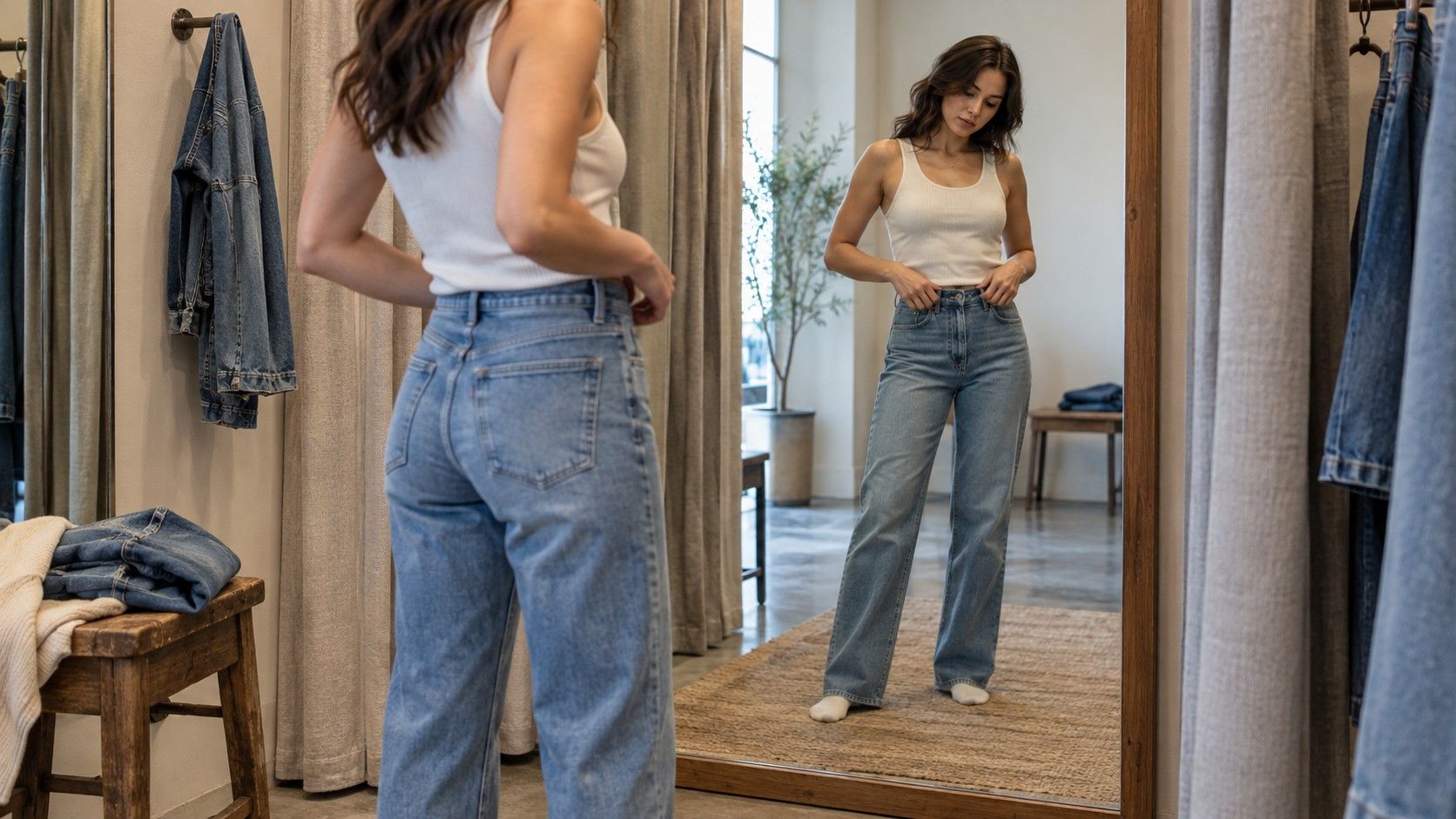
Wide-leg trousers, pleated trousers, A-line skirts, and jeans with a relaxed leg can bring attention down from the shoulders without looking like a costume. The key is proportion at the waist. A very low rise may lengthen the torso but can make the whole outfit feel unanchored; a mid or high rise usually gives the top and bottom a clear meeting point. Check the back view, especially with trousers that have front pleats. The fabric should hang, not spread open from strain.
Colour and texture help when you do not want more volume. A soft knit on top with darker denim below is an easy contrast. A patterned skirt, an interesting trouser weave, or visible pockets can make the lower half feel present without adding layers. Avoid treating this as a prohibition on light tops or dark skirts. It is simply a dial: strong contrast gives a stronger balancing effect, while similar tones make a calmer vertical column.
Choose necklines and sleeves for the day you are dressing for
V-necks, scoop necks, open collars, and narrow U-necks tend to direct the eye down and through the centre of the body. They can be especially comfortable when a high crew neck feels crowded under a jacket. Check the depth while bending forward and while seated; a neckline that looks fine for two minutes can require constant adjustment at a desk. A camisole or fine tank underneath is often a simpler answer than rejecting the top.
Sleeves deserve the same practical attention. A clean set-in sleeve, a soft raglan, or a sleeve with fullness below the elbow generally keeps the shoulder line readable without making it larger. Cap sleeves and shoulder ruffles are not forbidden, but they deliberately bring focus upward. Use them when that is the point. For a dinner outfit, a defined shoulder can look fantastic; for a balanced everyday look, a sleeve that falls smoothly from the shoulder is easier to combine.
| Outfit element | Typical effect | Check before keeping it |
|---|---|---|
| V-neck knit | Creates a vertical centre line | It sits flat at the chest |
| Wide-leg trouser | Adds presence below the waist | The hem clears your usual shoes |
| A-line skirt | Introduces movement from the waist | It does not twist when walking |
| Single-breasted jacket | Frames rather than widens the upper body | The shoulder seam ends at your shoulder |
Use trouser and skirt cuts as a fitting exercise
For jeans, try straight, bootcut, relaxed, and wide-leg pairs in the same rise. The leg shape affects balance, but fit at the waistband comes first. Sit on the fitting-room bench, take a few steps, and check whether the waistband gaps at the back. A belt can polish an outfit, but it should not be the only thing stopping jeans from sliding. If the hips are comfortable but the waist gaps, a small alteration is often more useful than sizing down and sacrificing movement.
Skirts offer another route. An A-line mini, bias midi, or gently pleated skirt gives the lower half motion without needing a huge silhouette. The hemline changes the result: a midi that ends at the broadest part of the calf may feel less fluid than one that ends just above or below it. Move in it before deciding. Walk, sit, and climb one step if possible; clothing that works only when standing still is rarely a good long-term buy.
Keep your personal style visible
Inverted triangle body shape clothes should still look like your clothes. If you love tailored shirts, wear them with trousers that have an interesting leg shape. If you prefer minimal outfits, choose a simple column of colour and let fit do the work. If you like vintage details, a defined waist and full skirt may feel natural. Balance is an option, not a duty, and an outfit can intentionally emphasise the shoulders when that feels powerful or joyful.
Build a small rotation from pieces that pass a real-life test: can you reach a shelf, carry a bag, and sit through a meal without rearranging them? Keep notes on the combinations you repeat. Over time, you may find that the most reliable formula is not a prescribed neckline or trouser shape but a certain rise, jacket length, and amount of contrast. That is a far better guide than a rigid body-type rulebook.
A small fitting routine saves repeat purchases
Before committing to any top or bottom, wear the outfit with the shoes and bra you normally use, then photograph it from the front, side, and back. Check whether the fabric still sits well after ten minutes instead of only at the first mirror glance. A piece that needs constant tugging is not more flattering because it is fashionable; it is simply demanding too much attention.
This routine also helps separate a useful proportion choice from a passing idea. Keep the trousers that feel easy, the neckline that stays put, and the jacket that allows your arms to move. Over several wears, those details form a personal style system that is kinder and more accurate than any body-shape rule.